How resellers sell returned pairs and clothing on Vinted
Every reseller ends up with stock that can't go back where it came from. A StockX reject, a buyer's return, a pair with a crushed box and a hoodie with cut tags all land in the same pile. Most of that pile sells on Vinted. The work is in the listing: an honest grade, the real cost, your own photos and one item for each piece.
 The RestocksAIO teamOperators, not flippers
Why returned stock goes to Vinted
Returned stock is rarely new enough for the marketplace that sold it first. StockX's Verified Marketplace takes new pairs in their original box. A pair with a scuff, a missing lid or two wears needs a buyer who accepts used condition. Clothing has the same problem: a piece from a mixed lot or a return without tags isn't new.
Vinted is built for that stock. Its buyers expect used items and read the condition notes. A private seller pays no seller fee on Vinted, because Vinted charges the buyer a protection fee instead. So the payout of a private Vinted sale is the item price. Check your country's current Vinted rules if you sell as a business.
Grade each item before you photograph it
Decide the condition first, because the photos must prove it. For a pair, record three facts: the condition, the box and the defect. RestocksAIO uses New, Used or New with defects for the condition. For the box it uses Good Box, Missing Lid, Damaged Box or No Original Box. A short note such as "scuff on the left toe" tells the buyer where to look.
Clothing needs a grade too, and no official standard exists. Wholesalers that sell by the kilo write their own. Friptadium's guide to Grade A clothing defines it as very good condition, with no holes, no marked stains and working zips. Use one written scale for every piece, so a buyer reads the same standard on each item.
Keep the real cost of each piece
A returned pair keeps the price you paid for it. In RestocksAIO, select the sale in Sales and choose Returned: back to Inventory. The pair goes back as Available, with its unit ID, its cost and its stored photos. The old sale stays in Sales as Refunded and leaves the Profit, Fees and Awaiting payout tiles. Don't create a new unit for that pair, or it gets a second cost.
Clothing bought by weight has no price per piece on the invoice. Friptadium sells clothing boxes by the kilo, sorted by category. Its items-per-kilo calculator gives a range for each clothing type, for example 5 to 7 T-shirts or 1 to 2 pairs of jeans per kilo. Divide the box price by the pieces you can sell, not by all the pieces. That number is the cost to type on each unit.
Store the photos once and use them on every channel
Vinted accepts only your own photos. Stock pictures and pictures from the internet aren't allowed. For returned stock that's the right rule, because the buyer wants to see this pair. Photograph both sides, the sole, the size label, the box label and every defect while the item is on the table.
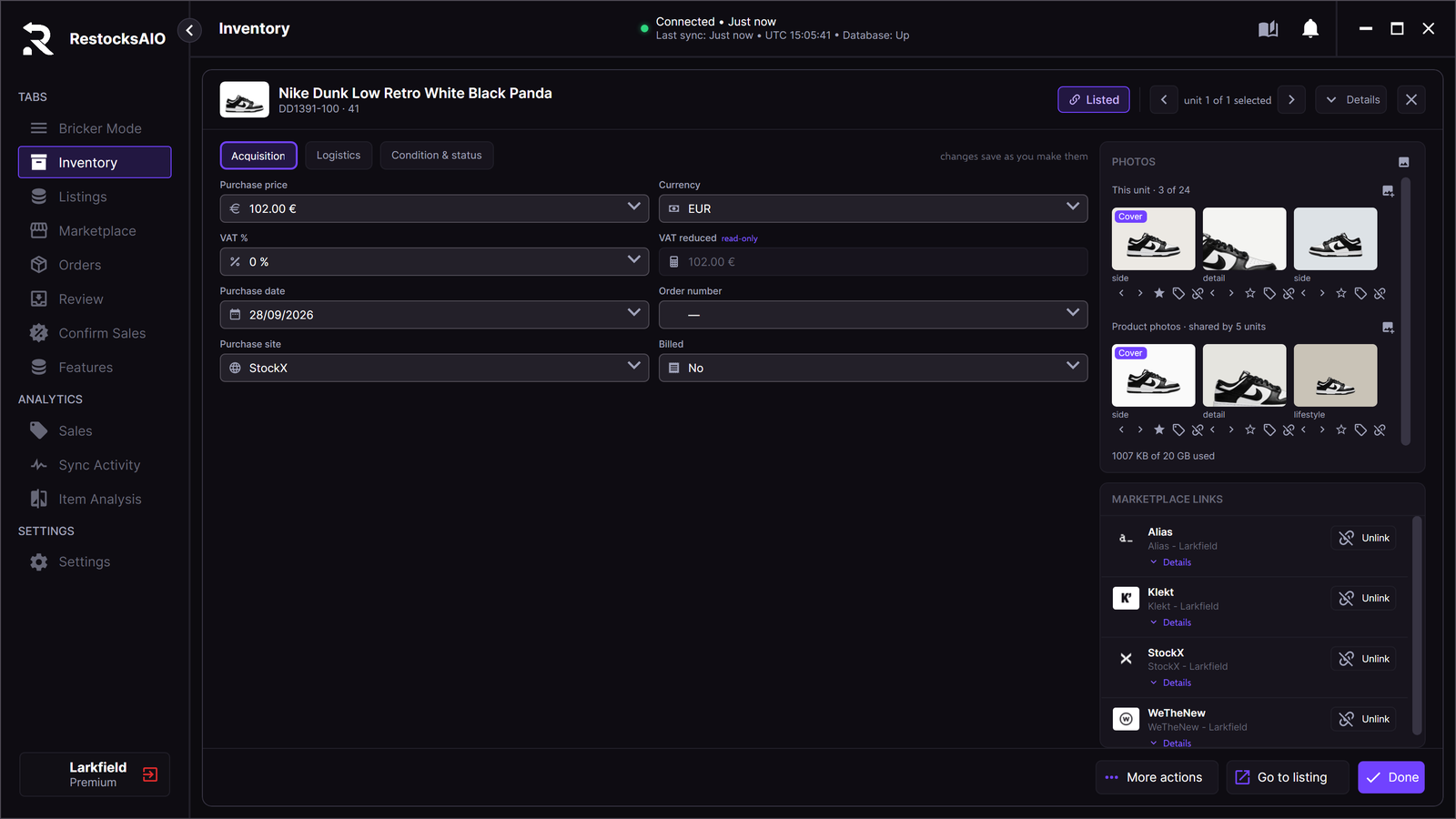
RestocksAIO Photo storage keeps those photos online and links them to a unit, a product or a group. Unit photos show the real pair. Product photos cover every unit of the same style code. Each target holds up to 24 photos, and Premium includes 20 GB per account. The service converts each photo to JPEG and removes the camera and location data.
If the pairs aren't in RestocksAIO yet, select their photos in Inventory → Photos and click Create inventory items. Recent versions read the box-label barcode in each photo and fill the SKU and size. Each stored photo has a public address, so never photograph shipping labels or addresses.
List one Vinted item for each pair
Vinted has no quantity and no size variations, so each pair is its own item. Each item needs a title, a colour and between 1 and 20 photos. The RestocksAIO Publish Composer sends the unit's stored photos to Vinted, never catalogue pictures. It matches the size through the brand's size table. When Vinted has no exact size, it uses the nearest size within a third of a size and warns you. Further away, it refuses the item.
Vinted has no public seller API. RestocksAIO sends the same requests as the Vinted website, and Vinted can restrict accounts that automate their activity. Publish, reprice and relist a small number of items each day.
PlatformVintedPublish, reprice, delete and relist Vinted items, and read your Vinted sales.Close the other listings when it sells
A used pair often sits on Vinted, Wallapop and eBay at the same time. RestocksAIO reads your sold Vinted orders. The sale uses up the linked unit, and RestocksAIO then updates the other store listings of that unit. Ship the order through Vinted, because RestocksAIO doesn't buy Vinted labels or read Vinted payouts.
If a buyer cancels after the unit is used up, RestocksAIO shows the order for review. It doesn't put the unit back in stock by itself, so check the pair before you list it again.
Related reading
All articles
Streetwear reselling across footwear, clothing and accessories
A streetwear inventory workflow for footwear, apparel and accessories that keeps each category's sizing and condition, from intake to listings, payout and fulfilment.
One resale inventory across sneakers, streetwear, cards, electronics and luxury
How a multi-category reseller keeps one workflow for owned units, listings, pricing and documents, while each category keeps its own checks.
How to avoid overselling when you list on five marketplaces
Overselling is the most expensive mistake in multi-platform reselling. Here is how to prevent it by design instead of catching it after the second order lands.