Best Retail Bot: How to Choose Software That Delivers Real Results
A retail bot is automated purchasing software designed to monitor web store inventory, handle queue navigation, and execute automated online checkouts during high-demand releases. Secondary market sellers and collectors rely on these tools to acquire limited items across platforms like Amazon, Walmart, Target, and Best Buy before public stock sells out. Utilizing automated checkout software remains the standard approach for managing multi-account tasks and maintaining consistent order success across major retail drops.
 Guest contributorRetail buying guide
What Is a Retail Bot?
A retail bot is specialized software that automates the online purchasing process from product discovery to final payment settlement.
The software continuously queries marketplace endpoints or monitors site frontend scripts for inventory updates. When stock is detected, the program automatically adds the target item to the cart, solves perimeter security verification challenges, injects saved billing profile data, and submits payment details in milliseconds.
Automation Note: A retail bot operates based on exact user configuration parameters. Success depends on proxy quality, server latency, valid account details, and realistic task delays rather than the software alone.
Hardware resource usage varies depending on setup size. Running hundreds of simultaneous tasks requires stable proxy subnet routing and dedicated virtual private servers to maintain low network round-trip times during site drops.
[ Monitor Task ] ---> (Detects Stock Restock)
         |
[ Checkout Engine ] -> (Bypasses Queue & Solves Captcha)
         |
[ Account Module ] -> (Applies Saved Billing & 2FA Code)
         |
[ Payment Submission ] -> (Order Confirmation / Webhook Log)
How Much Do Retail Bots Cost?
Retail bot costs range between $300 and $2,000 for initial licensing. Recurring renewal fees range from $50 per month to $150 per quarter. The current market leaders in that field are bots like NikeShoeBot, as well as Refract, Stellar, and Valor.
Software licensing represents only a portion of total operational capital. Running automated tasks effectively requires additional monthly investments in proxy subnets, server hosting, and aged retail accounts.
| Retail Bot | Supported Core Retailers | Operating System | Estimated Entry Pricing | Target Workflow Focus |
|---|---|---|---|---|
| Refract | Amazon, Target, Walmart, Best Buy, Apple | Windows, macOS | $1,999 initial (3 months), then $50/mo | High-speed retail, 2FA inbox automation, task scheduling |
| Stellar AIO | Amazon, Walmart, Target, Best Buy, Home Depot | Windows, macOS | $499 initial (3 months), then $150/qtr | Multi-category retail, trading cards, collectibles |
| Valor AIO | Nike SNKRS, Shopify, Target, Walmart, Pokémon Center | Windows, macOS | $1,999.99 initial (30 days) with renewals at $49.99/mo | Hybrid sneaker drops, regional retail restocks |
| NikeShoeBot | Demandware, Shopify, Nike, Major Retailers like Pokémon Center, Walmart, Amazon, Target, and EU retailers | Windows, macOS | $499 (6 months) with occasional discounts | Cross-category automation, AIO flexibility, multi-market |
Evaluate full operating expenditures before purchasing software. Your operational budget must account for base license fees, ISP proxy subnets, residential bandwidth allocations, and aged site accounts.
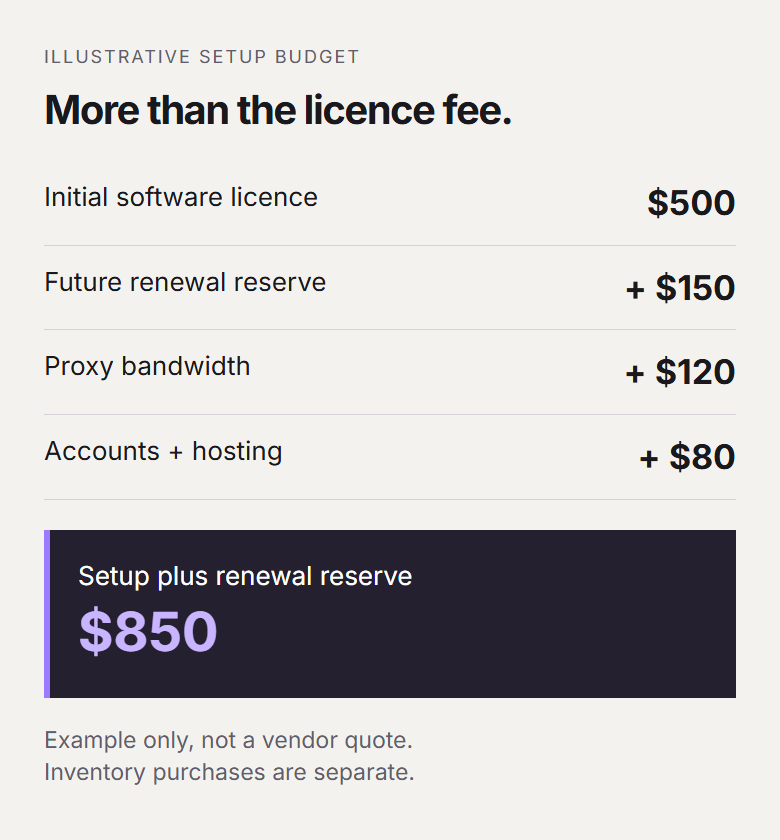
Illustrative budget, not a vendor quote. The renewal reserve is for a future billing period, not an additional charge for access already included in the initial licence. Inventory purchases are separate.
 $500  (Initial Software License Fee)
+ $150  (Reserve for the First Renewal)
+ $120  (Residential & ISP Proxy Bandwidth)
+ $80   (Aged Retail Accounts & Server Hosting)
------
= $850  (Illustrative Setup Budget Including Renewal Reserve)
What Items Can You Buy Using a Retail Bot?
Pokémon TCG, collectibles, and limited-edition sneakers.
Retail bots are used to secure high-demand, limited-quantity consumer items that resell above retail value due to supply shortages.
Automated checkout software targets specific product categories across major retail marketplaces where manual checkout speeds are insufficient. High-value target categories include:
- Trading Cards & Collectibles: Pokémon Booster Boxes, Panini Sports Sealed Cases, and Magic: The Gathering collector sets restocked on Target, Walmart, and Pokémon Center.
- Gaming Consoles & Electronics: Next-generation gaming consoles, high-end graphics processing units (GPUs), and limited-edition gaming handhelds restocked on Best Buy and Amazon.
- Limited Footwear & Apparel: Hype sneaker releases, designer streetwear collaborations, and regional apparel drops on Shopify and Demandware storefronts.
- High-Demand Seasonal Goods: Pool supplies, outdoor power equipment, heating units, and high-demand household electronics on Home Depot and Lowe's.
Diversifying across multiple product categories creates consistent order flow throughout the year, reducing reliance on seasonal sneaker or console release schedules alone.
What Retailers Should a Retail Bot Support?
Amazon, Walmart, Target, Best Buy. The more the merrier.
A capable retail bot must maintain functional checkout modules for major high-volume merchant platforms.
Targeting a single website limits acquisition opportunities during major release events. The core sites every competitive reseller tracks include:
- Amazon: Requires specialized offer ID monitoring algorithms and fast checkout flows to bypass account rate limits during sudden restocks.
- Walmart: Demands advanced queue bypass protocols and account session handling for hype releases and trading card drops.
- Target: Requires reliable local store pickup routing and account profile synchronization to navigate anti-bot protections.
- Best Buy: Depends on automated queue navigation and account 2FA verification parsing.
Ensure the software you choose receives continuous module updates. When merchant site architectures change, developer responsiveness determines whether your tasks succeed or trigger immediate declines.
How to Choose the Best Retail Bot?
Selecting the best retail bot requires evaluating anti-bot adaptation history, module stability, proxy handling, and total operating costs.
Evaluate developer update frequency before committing to long-term licenses. Anti-bot protection providers like Akamai, Cloudflare, and Datadome update detection rules constantly; software without timely updates can encounter checkout failures.
Test task creation workflows in a local sandbox or low-value restock environment. Confirming profile importing, captcha routing, and Discord webhook logging beforehand prevents setup mistakes when major drops go live.
What Proxies Work Best for Retail Botting?
Datacenter proxies provide maximum speed for initial drop seconds, while residential proxies offer better IP trust scores for strict queue checkouts.
According to proxy network performance tests, static ISP proxies combine the low-latency benefits of datacenter hosting with residential ASN classification. Using premium ISP proxies on sites like Target and Walmart reduces soft bans during long monitoring tasks.
Assign distinct IP addresses across task groups to avoid IP rate-limiting penalties. Running many tasks through a single proxy address can trigger rate limits or security blocks.
How Do You Maintain Retail Accounts Without Getting Banned?
Retail merchants score buyer account trust using historical order activity, age, IP consistency, and payment matching.
Avoid creating dozens of accounts immediately before a high-profile drop. Aged accounts with verified purchase histories pass anti-bot risk checks significantly better than freshly generated profiles.
Vary profile details across accounts. Reusing identical credit card numbers, delivery addresses, and proxy IPs across multiple accounts increases the probability of cross-account linking and order cancellations.
Build an Operational Setup That Scales
Select a retail bot that matches your target retail sites, maintain updated proxy subnets, and configure tasks carefully. Once checkouts settle and orders arrive, managing stock across multi-channel marketplaces becomes the next priority. Pairing reliable checkout software with systematic inventory tracking creates a sustainable reselling operation.
Related reading
All articles
Sourcing at retail: finding the pair before you promise it
Listing stock you do not hold only works if you can actually find the pair at a price that leaves a margin. Here is how to check retail before you commit.

How to tell a real discount from a marked-up sale
A percentage off tells you about one shop's own pricing history. It tells you nothing about whether you are getting a good price. Here is what to check instead.