Product IDs required for eBay shipments into the EU
From 1 November 2026, an item you ship from outside the EU to a buyer in the EU needs product identifier data, whatever it costs. The listing ID is not the same as a maker code or a barcode.
 The RestocksAIO teamOperators, not flippers
What changes on 1 November 2026
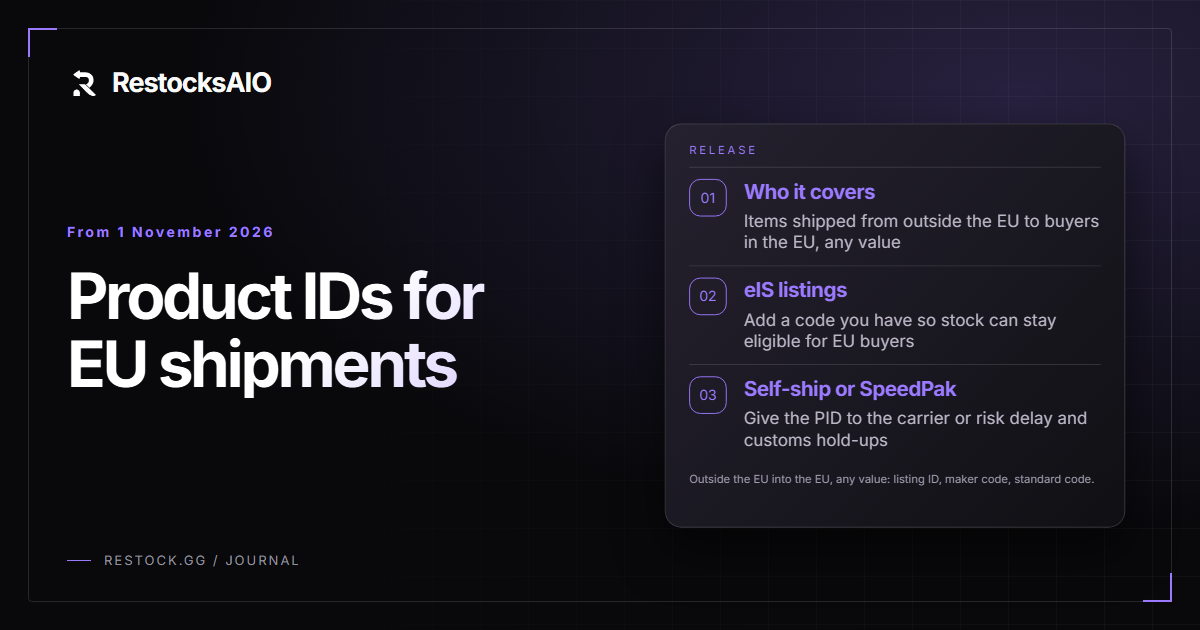
From 1 November 2026, every item you ship from outside the EU to a buyer in the EU needs product identifier information. The rule applies at any item value. Customs uses the identifiers to name the specific product in the parcel.
Review each listing and add a manufacturer code or a standard product code where you have one. If you use eBay International Shipping, that helps the listing stay eligible for EU buyers. eBay says it will share more guidance. It also says some categories will not have a separate manufacturer code.
The three codes are not interchangeable
eBay splits the requirement into three codes.
- M-PID is the merchant product identifier. It is the eBay listing ID. You already have it on every listing, under About this item.
- NS-PID is the non-standardised manufacturer product identifier. It is a code from the manufacturer, producer or supplier, such as a manufacturer part number. A published example is the Google Pixel part number GA09765-US-PREM.
- S-PID is the standardised product identifier. It is a code used across markets, such as a GTIN, EAN, UPC or ISBN. In that same phone example, the UPC is 026591442234.
Those phone numbers only show the shape of each field. They are not sneaker codes. Where an S-PID exists, that same code can also be used as the NS-PID. If you do not know the NS-PID, the advice is to search for it. Do not guess a code. Some categories will not have a separate NS-PID, and further guidance is still to come.
eBay International Shipping is not the same as self-ship
The date does not change with the shipping method. The consequence does.
With eBay International Shipping, adding a manufacturer or standard code where you have one helps the stock stay eligible for buyers in the EU. eBay has not said that a listing without an extra code is removed from search. The confirmed point is eligibility for EU buyers on that service.
If you ship the parcel yourself, or you use SpeedPak, you must give the required product identifier to the carrier. Without it, eBay warns of delivery disruption, longer processing time, or other customs clearance delays. It does not say every parcel will be stopped.
The test is the route. The item leaves a place outside the EU, and the buyer is in the EU. Item value does not switch the rule off.
What to record on a sneaker listing
On a sneaker, use the code that identifies that pair, not the nickname. A style code is the sort of manufacturer code an NS-PID is meant to hold. A barcode on the box is often an EAN or a UPC, which is the S-PID. Two shoes can share a name and still be different products. Match the code to the pair you will actually ship. The style code versus nickname guide shows why that check matters before you compare listings.
Record the eBay listing ID as the M-PID. It is already under About this item. Add the style code as the NS-PID when you have it. Add the EAN or UPC as the S-PID when the box or the brand data shows one. If a standard code exists, eBay says you can also use it as the NS-PID.
If you self-ship, give those same codes to the carrier, not only to the listing. A delayed parcel is still your sale to document. Keep the label and proof of delivery with the order, as set out in the shipping labels and proof of delivery guide.
Check listings that can ship into the EU before 1 November 2026. If you cannot find a real code, do not invent one. Wait for the extra guidance eBay said it will publish.
Related reading
All articles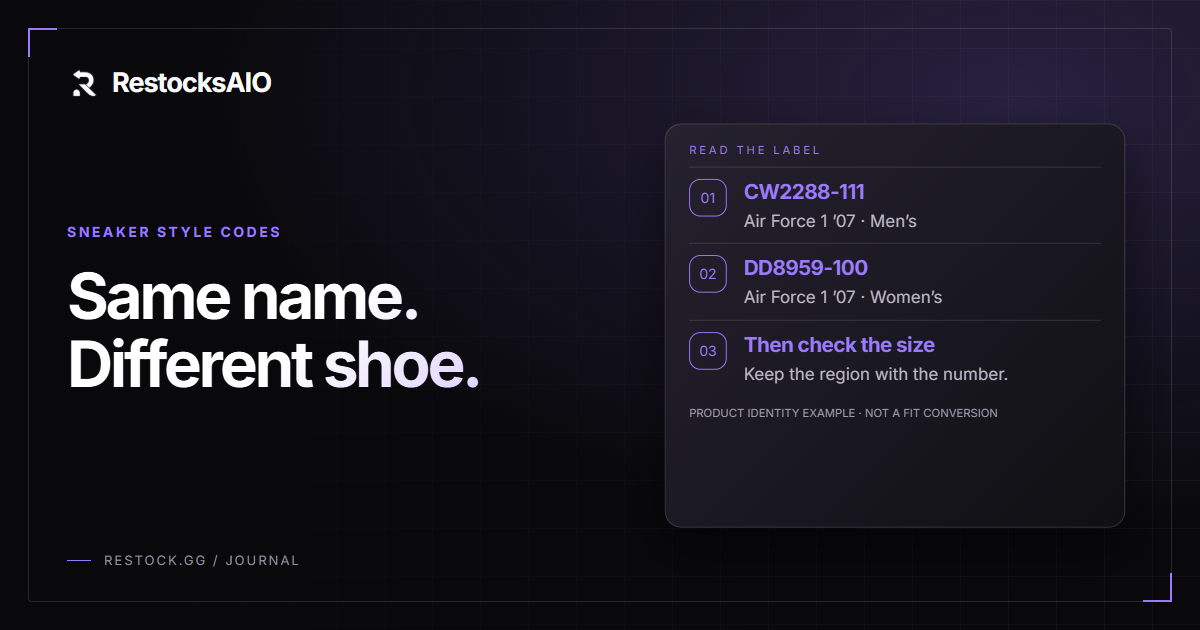
Same sneaker name, different shoe: why the style code matters
A white Air Force 1 is not one product. Check style codes, editions and size labels before comparing two sneaker listings.
Shipping labels & proof of delivery: protecting yourself on every sale
A sale is done when you can prove it was delivered, not when it ships. Here's how to generate labels from the sale and keep proof of delivery for every parcel.